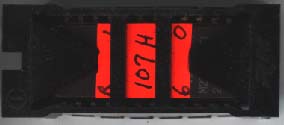
 Chip burning and EPROM calibration is an art unto itself. If done improperly, it can result in damage to the engine. Anyone wishing to burn their own chips should understand the risk inherent in the activity. The following article is submitted by a member as information only and not meant to be a complete "How to". The article assumes an advanced level of knowledge about the stock EPROM calibration tables and variables. Questions, comments, and suggestions should be directed to the AUTHOR (email address is at the top of the article).
Not to be attempted without adult supervision. You're on you own for your own screwups. You can detonate a motor to death.
This is just what works for me, other may have their own madness, and ways of doing things. If you have no patience, and like instant gratification, find another hobby, this take lots of work.
If you don't like note taking, find another hobby.
If you like assuming things, find another hobby.
If you think you need to see numbers that satisfy you, rather then the engine find another hobby.
If you lack the discipline to follow ALL of the ABOVE, FAH.
Not to be reprinted, reproduced, or regurgitated, without Bruce Plecan's written consent.
- **The First Rule is Making the Engine Happy**
- **The Second Rule is Understanding what is Making the Engine Happy**
- **The Third Rule is Remembering the First Rule**
- A scanner
- A bin file editor
- A chip burner
- A chip eraser
- Some Chips
- Some accurate way of figuring out your *running* AFR. No you can't use the OEM O2 sensor. Contrary to old wife's tales they just aren't accurate enough. If you think you can, just be ready to replace headgaskets, and rod bearings.
- Trick Tools to make it easier, faster and more accurate:
- An ECM Bench
- A true Wide Band O2 sensor (WB)
- Data Logging, to include the Wide Band O2
- ***A Translator, or Translator Plus, are recommended.
The OEM MAF, and ECM just have some design problems, that when pushed to the limits of OFF-ROAD use, rear their ugly heads.***
Since we're concentrating on OFF-ROAD Applications and not worried about emissions:
- The first thing we're going to do is kill this Closed Loop stuff.
Why?.
Because it just toggles the AFR across 14.7 so the engine spends too much time being too lean, and too much time being too rich. This toggling is for the catalytic converter. If you want to run 14.7, that's fine, and a good safe AFR for idle and cruise conditions. Set the Closed Loop (C/L) Enable Temp to some ridiculously high temperature, and then disable the code 13, 44, and 45
And while disabling things, set the EGR Enable Temp to a very high temperature., and disable
it's code. And, might as well set the Charcoal Canister Purge Operation Enable to some high temperature
- We're going to enter the correct injector constant, and leave it alone from here on out.
Why?
Because we're going to tune things up correctly and won't need to make any Mickey Mouse fudges to get things CORRECT.
- Install and verify the operation of the scanner, and WB.
- The first thing to realize, is that if you've so much as changed the Air Filter, you've trashed the MAF Tables and Scalers. The only thing that's allowed folks to band aid past that is the extreme forgivness of the MAF system to things being wrong, and it's ability to tune around the Tuner.
If you take the scaler and multiply it by a particular entry, and then divide it by 255 that tells you what reading in gm/sec that particular frequency represents.
In quick review:
The GN ECM works on a frequency based MAF. Meaning that 30 cycles per sec., represents idle, and the upper limit is 140 cycles per sec (from here on out we're going to get real technical, and call this cycles per sec.,Hertz {Hz}).
So we're going to start with trying to get the engine to idle. It's been so long since I've worked with the stock stuff, I'm just going to pick numbers at random to illustrate what's going on.
OK, so we know an engine is going to like 6-8 gm/sec at idle. As things work out setting the scaler to 8 for table one, just makes things easy and convenient. With a last entry of 255 that would mean that table one now covers, 0-8 gm/sec. An entry of 128 would be 4 gm/sec. So you can now look at what value (gms/sec) represents what frequency the engine is idling at. By changing the entry a value of 20 say from 128 to 108 or to 148, you can see the change that it makes on the AFR displayed with the WB.
Just by example: a table entry of 64 in table one, with a scaler of 8 would mean 2/gm/sec. An entry of 128 would be 4 gm/sec, and an entry of 255 would be 8.
You can immediately see how fine of granuality using a small scaler number gives you. You can split the AFR (gm/sec) at any frequency to a really fine degree of resolution.
The base timing of 24 is just fine for any stock cammed engine. If you have an aftermarket cam (say a 206/206) then you might want to bump it up to 26-28d. The
only reason to bump the timing at idle is for when you've done a cam change, and changed the self EGR'ing effects of the motor. Reducing the exhaust back pressure will help negate needing to advance the timing at idle.
Now, you just need to dial in what makes your engine actually HAPPY. And, NO a RICH idle that makes the engine run smooth is not making the engine actually happy. You want to run the least amount of fuel at idle that maintains an ACCEPTABLE idle to you. As long as the engine isn't actually missing, it's just fine. There is a *lean roll* (lean surge), that is just a tad too lean
If you thing you need a smooth idle, then a V8 is a much better engine for you to work on. There are 25% fewer firing pulsations at a given RPM with a 6 then an 8, so there will always be some *roughness* to the idle. Given time with a WB, and tuning you'll see what I mean. Again, we're talking about relative terms here, and until you spend enough time playing with it, you'll won't understand the *relativeness* of it all.
OK, So we got the engine to idle now.
Now we'll set the PE vs TPS enables to approximately 40ish%. That way we can tune the various frequencies to gm/sec areas.
If you look at tables 2-5, they use various scalers. Since we're not doing anything resembling EPA certification, we can take some huge shortcuts. Instead of spending all day multipling and dividing the scalers and MAF Tables out. we're just going to change the scalers on these four tables to 255. That way we can read out the gm/sec directly.
For example: Say we're at 20 grm/sec at 70 MPH, and reading lean. All we have to do is look at where the **20** is and change that to say 22. And make sure the adjacent numbers to it make sense. I have yet to see a GN that has enough reversion to dither the progression of the numbers other then to be increasing.
And now that you actually know how, and can understand what you're doing, you can remove the screens, and anything else you want to do to the MAF. BUT, be aware that you can get too crazy, and get a MAF that might not always work. There seems to be some critical velocities in the MAF, break one of the rules, and the MAF is a dodo.
WOT timing:
Now here's where you can really screw up an engine.
Instantly.
The universal statement of "If you have detonation, the cure is retarding the timing, is sometimes wrong." Just for the sake of keeping this a reasonably short .discussion, we'll lump preignition and detonation together. If your engine is actually going into preignition, that means a flame front is starting in the chamber before the spark plug initiates the reaction. One POSSIBLE cure is firing the plug earlier, so that the proper flame front is started first, and that MAY eliminate the chance of the PreIgnition front from starting. Detonation, Preignition, Tip-In detonation, can take hundreds of chips for you to get a grasp of how much fuel and timing an engine actually needs.
OK, now that we have the ability of the car to idle and at least cruise with the AFRs being resonable. We can get into the AE stuff. This is where we start to spend ALOT of time.
You can begin with resetting the PE Enables to the factory levels. There is a fine line from AE stuff to PE stuff, for the new guy. The difference being AE is just for a given amount of time. PE is for as long as you're in PE mode. It's also where going static can screw things up.
AE *shots* are mostly taken care of with LV8 AE, and TPS AE. There are lots of minor perimeters like coolant temp corrects and max lengths, but for the average guy, I'd strongly recommend KISS (Keep It Simple Stupid). If you get the Timing table right and the MAF stuff correct, you'll flat be amazed in how well a GN really runs.
Not to be reprinted, reproduced, or regurgitated, without my written consent.
- This is GN specific.
- If in doubt, about something, ask someone. You can really tune yourself into a corner. ie, once you make a mistake you can compound that error.
- Always keep you baseline chip handy.
- Always carry a spare ecm.
- Too rich, and you'll be replacing spark plugs, too lean and you'll be replacing at least headgaskets. I consider replacing plugs as the better of the two ways to error.